Recently, the Office of the National Commission for Disaster Prevention, Reduction and Relief and the Ministry of Emergency Management, together with the National Food and Strategic Reserves Administration, allocated central disaster relief supplies to support the resettlement and assistance of affected residents in Hebei and Henan. As disaster relief efforts continue, safety management at post-disaster cleanup and reconstruction sites has become a top priority. For employees or volunteers involved in rescue and inspection work, personal protection in complex environments must not be overlooked.
After floodwaters recede, sites often leave behind large amounts of mud and garbage, and some building structures may be damaged, posing risks of wall cracks or falling objects from heights. In addition, humid environments are highly prone to the growth of mold and bacteria. Blindly entering unverified disaster-affected areas can easily lead to secondary safety accidents or health risks.
During the cleanup of damaged buildings and the handling of disaster relief supplies, head protection is the primary line of defense. On-site workers should wear safety helmets with good impact resistance. Considering that post-disaster sites may involve a lot of bending and lowering of the head during cleanup operations, it is recommended to choose safety helmets equipped with anti-slip chin straps to ensure that protective equipment does not accidentally fall off in complex postures.
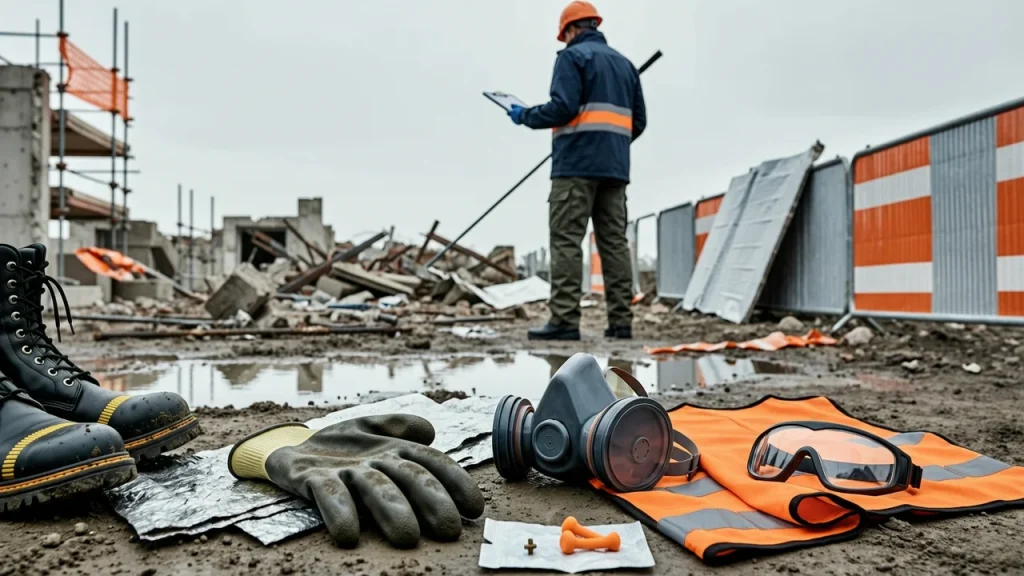
The air quality after floodwaters recede also requires vigilance. When cleaning mud and moldy items, the air will be filled with large amounts of dust, mold spores, and potentially harmful gases. On-site personnel should select appropriate respiratory protection equipment based on dust concentration and gas composition, such as dust half masks or disposable masks with odor reduction functions, to avoid irreversible damage to the respiratory tract.
Enterprise safety managers must carry out on-site risk assessments when organizing post-disaster return-to-work inspections. Before personnel enter affected areas, safe access routes and restricted hazard zones should be designated in advance, and everyone entering the site should receive a safety briefing to ensure that all PPE is worn and used correctly.
Post-disaster recovery is not only about reallocating supplies; safe working conditions must also be re-established. Identifying site hazards and providing suitable head and respiratory protection are basic requirements for protecting rescue and reconstruction workers and for meeting a company's work-safety responsibilities.
News source:Ministry of Emergency Management of the People's Republic of China, 2026-08-12: "The Office of the National Commission for Disaster Prevention, Reduction and Relief and the Ministry of Emergency Management, together with the National Food and Strategic Reserves Administration, allocated 20,000 items of central disaster relief supplies to support the resettlement and assistance of affected residents in Hebei and Henan." This article provides PPE-related interpretation based solely on publicly available news topics.