
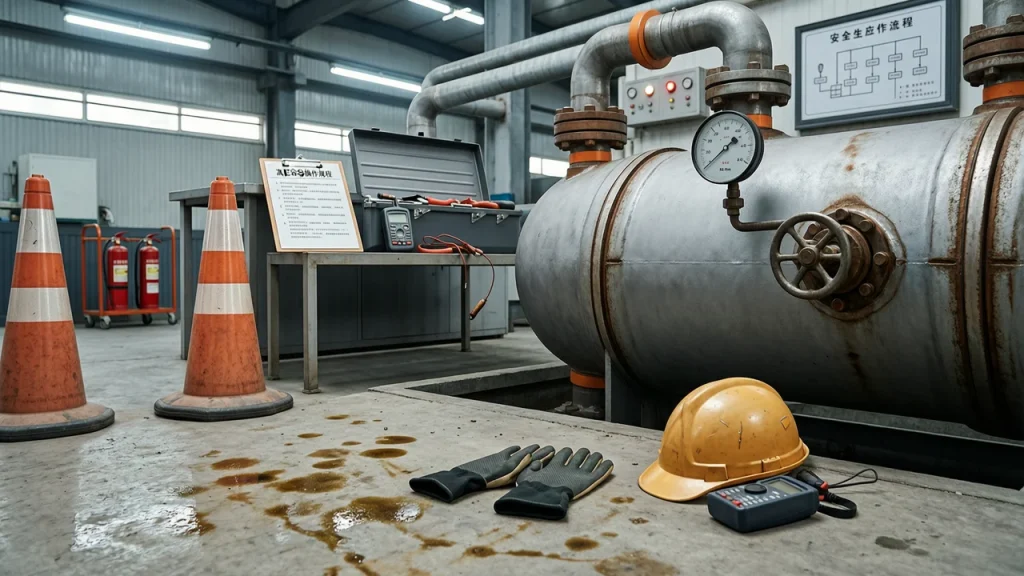
The release of the investigation report on the major vessel explosion once again places pressure vessels, process abnormalities, and on-site management at the center of corporate safety management. For factory EHS, an accident investigation is not just about post-incident accountability, but also an opportunity to review one's own equipment, inspections, changes, and emergency response.
Vessel-type equipment often involves combined risks such as high temperature, high pressure, leakage, noise, and dust. Once equipment overpressure, valve failure, medium mixing, or incorrect operating sequence occurs, risks can escalate within a short time. Enterprises need to link process parameters, interlock status, inspection records, and operating permits to form a traceable on-site control chain.
From a PPE perspective, personal equipment cannot replace engineering controls, but it can provide the last line of protection during abnormal exposure, short-term leaks, noise impacts, and emergency evacuation. Procurement and safety management personnel should avoid the inertia of “uniform distribution” and reassess configuration standards based on job risk, work duration, ambient temperature, and wearing comfort.
In high-pressure or noisy equipment areas, head protection, hearing protection, and respiratory protection are the categories most easily overlooked yet directly related to consequences. AEGLE product categories such as head protection, hearing protection, and respiratory protection can serve as reference items for on-site risk checklists, helping EHS clarify which positions must wear them and which scenarios require upgraded protection.
In terms of management, PPE selection cannot rely only on individual parameters; it must also consider work processes. For example, before inspection personnel enter abnormal areas, do they need impact-resistant face shields, earplugs, or half masks; during emergency response, is a higher level of respiratory protection needed; for nighttime or high-temperature work, is it necessary to balance visibility and wearing stability?
The accident investigation report also reminds enterprises to focus on the closed loop of “people, machines, environment, and management.” Confirmation after equipment maintenance, temporary power use and hot work, response to abnormal alarms, and contractor entry management can all become risk amplification points. EHS should translate the risk logic in the report into internal checklists, rather than merely communicating it in meetings.
For factory procurement, it is recommended to establish a ledger of “risk—position—PPE—training—replacement cycle” and regularly update it based on inspections, drills, and employee feedback. Only by integrating protective equipment into daily operational management can exposure time be reduced and the probability of secondary injury be lowered when abnormalities occur.
News source:Safety Management Network, 2026-08-02: “Investigation Report on the ”1·18' Major Vessel Explosion Accident at Baotou Steel Rare Earth." This article only provides a PPE knowledge interpretation based on public news topics.