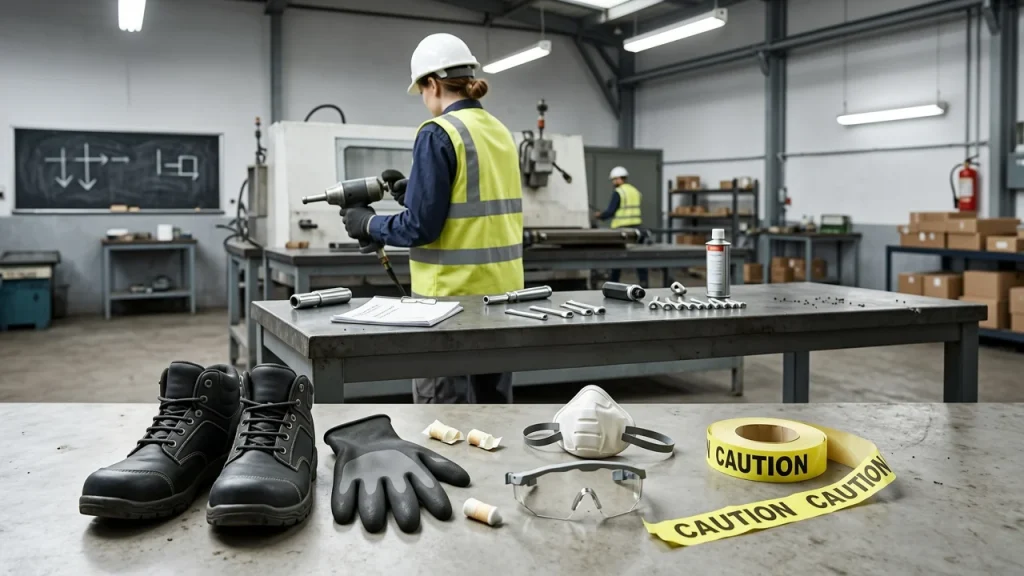
The start of a new production season may look like simply resuming operations, but in reality, workers' attention, on-site order, and the condition of protective equipment all need to be readjusted. After equipment restarts following a shutdown, materials, tools, and access routes may also change. Safety managers should not treat the start of work as a routine inspection, but rather as an opportunity to re-identify risks.
For frontline positions, head risks often arise during lifting, carrying, cross-operation in confined spaces, and temporary maintenance. Whether the safety helmet is clean, whether the chin strap is fastened, and whether the shell has visible cracks all affect actual protection performance. When purchasing, there is no need to pursue complex features, but attention should be paid to wearing comfort and ease of daily maintenance to reduce the likelihood of employees abandoning them due to heat or pressure discomfort.
Noise environments are also easily overlooked after work resumes. Once equipment is running again, noise levels at some positions may change due to rotation speed, load, or interaction with nearby equipment. Hearing protection is not simply “done” once earplugs are issued; it depends on whether employees wear them correctly and whether they maintain a proper fit over time. Hearing protection products such as earplugs and earmuffs are better allocated according to the noise characteristics of the position and the duration of work.
Respiratory protection, meanwhile, needs to be determined in light of scenarios such as dust, oil fumes, chemical odors, and confined spaces. During the start-up phase, cleaning accumulated dust, clearing pipes, replacing filter materials, or handling residual materials can all increase employee exposure time. When selecting respiratory protection, it is not enough to consider only whether it can block dust; fit, breathing resistance, field of view, and communication needs must also be considered to prevent employees from removing it on their own due to discomfort.
In on-site management, the risk with PPE often lies not in whether it exists, but in whether it is actually used. Many factories already have safety helmets, earplugs, and respiratory protection products, but problems remain, such as chaotic storage, damaged items not being replaced, incorrect sizes, and unclear shift handover. It is recommended to include PPE checks in pre-shift meetings so that employees can state the main risks of their positions and the corresponding protection requirements.
For corporate procurement, a review of inventory and suitability is more appropriate before work resumes. Taking AEGLE categories such as head protection, hearing protection, and respiratory protection as examples, inventories can be checked separately by workshop, team, and type of operation, rather than being purchased uniformly and then distributed to individuals. Size, replacement cycles, cleaning and disinfection methods, and employee feedback should all become the basis for subsequent replenishment and optimization.
Start-up risks are not frightening in themselves; what is frightening is treating protection as a one-time action. When PPE management shifts from “issuance records” to “position risk identification, on-site wearing supervision, and improvement of comfort experience,” employees are more likely to regard protective equipment as part of their working conditions. This kind of start-up inspection is more effective at reducing the probability of accidents than temporary slogans.
News source:Safety Management Network, 2026-08-02: 'Work Has Started! These Risks Need to Be Watched Out For.' This article only provides an interpretation of PPE knowledge based on publicly reported news topics.