A gas tunnel operator was summoned for talks. On the surface, this is a matter of rectifying major accident hazards, but it also exposes whether the management of “people, equipment, and environment” in high-risk operations forms a closed loop. For companies and EHS professionals, a tunnel is not an ordinary construction site: gas conditions, confined spaces, noise, and cross-operation all amplify risk. If PPE remains merely a distribution checklist, it easily becomes formalistic protection.
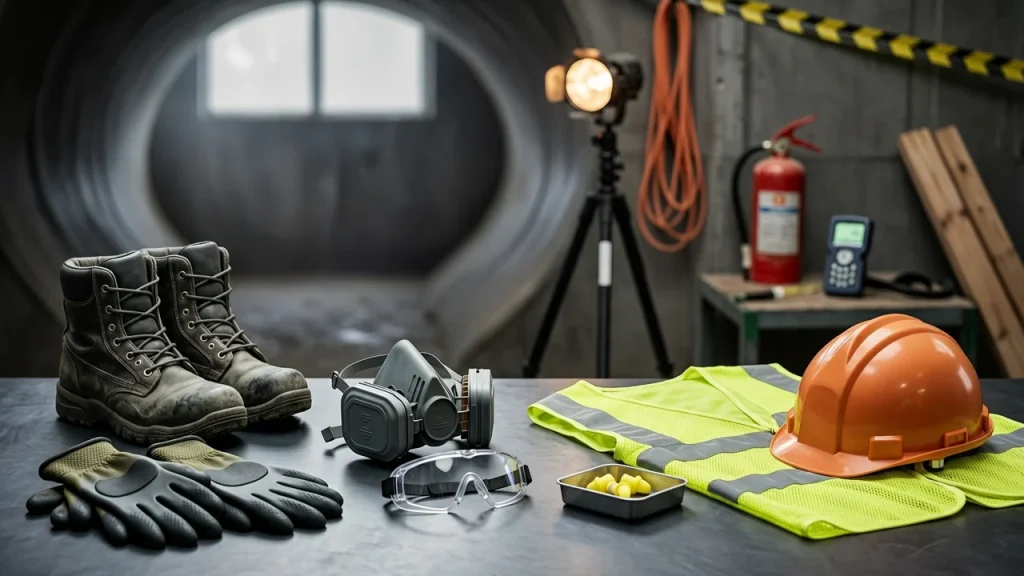
In tunnel operations, head protection is often overlooked. Narrow cross-sections, low supports, and cross-construction can all bring risks of impact and falling objects. When purchasing, do not focus only on appearance and weight; pay more attention to wearing stability, obstruction of vision, and compatibility with respirators or communication devices. In on-site management, helmets should be included in pre-shift inspections, and replaced if damaged, loose, or with failed liners.
Respiratory protection is a more critical category in tunnel scenarios. Gas, dust, exhaust, or poor local ventilation can all keep workers in an uncomfortable environment for long periods. The selection approach should not simply pursue the “thickest” or “densest,” but should combine the work area, dwell time, work intensity, and individual fit. When engineering controls can improve ventilation, they should be prioritized; PPE is a supplement, not a replacement.
Hearing protection is also easily treated as a “spare item.” Blasting, drilling, machinery operation, and vehicle traffic in tunnels generate continuous noise, and long-term exposure can affect judgment and emergency response. When purchasing, consider the applicable scenarios for earplugs and earmuffs; daily wearing comfort is equally important. If earplugs frequently fall out, even the best protection is useless.
The summoning of multiple units for talks reminds us that the focus of PPE management is not “what was bought,” but “whether it is correctly selected, correctly worn, and correctly maintained.” EHS personnel should establish PPE lists for high-risk positions, clarifying which positions must wear it, which areas are prohibited, and which situations require upgraded protection. Procurement departments should incorporate usage feedback into repurchase criteria, rather than looking only at price and brand.
For factory EHS, tunnel project experience can also be transferred to confined spaces, underground utility tunnels, equipment maintenance, and other scenarios. From AEGLE's categories such as head protection, respiratory protection, and hearing protection, the selection focus is not individual parameters, but matching with on-site risks. The key is to identify risks in advance: first determine gas, noise, falls, impacts, and mechanical injuries, then determine the level of protection.
Ultimately, PPE is not the end point of safety management, but the last controllable line of defense. After being summoned for talks, companies should pay more attention to whether hazards are systematically eliminated: whether ventilation is effective, whether detection is timely, whether work permits are implemented, and whether personnel training covers real risks. Only by viewing engineering measures, management measures, and personal protection together can the safety boundary of tunnel operations become clearer.
News source:Safety Management Network, 2026-07-31: "Major Accident Hazards Exist in Gas Tunnels; Multiple Units Summoned for Talks." This article only provides PPE knowledge interpretation based on public news topics.