
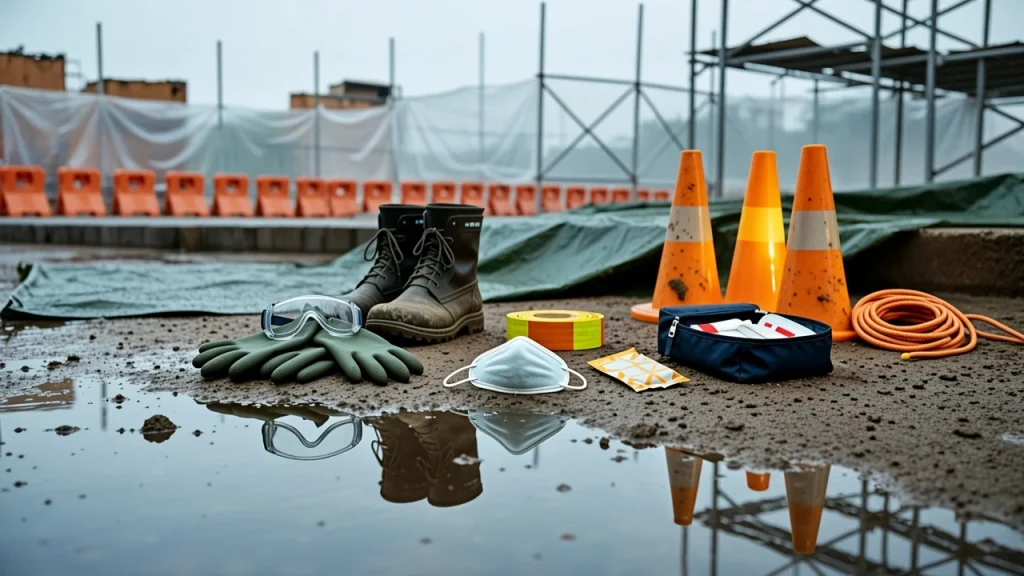
Recently, due to continuous heavy rainfall, some regions have activated disaster relief emergency responses, and flood disaster rescue and post-disaster reconstruction efforts are underway. For corporate EHS managers, whether participating in external rescue operations or dealing with internal flood control and drainage, the complex and ever-changing on-site environments place higher demands on personal protection.
Flood disaster sites often come with multiple risks. Damaged buildings may pose hazards of structural instability and falling objects, waterlogged areas are prone to bacterial and mold growth, and the continuous operation of large-scale pumping and drainage equipment generates high-intensity noise. Identifying these risks is the prerequisite for formulating on-site safety management plans.
When entering damaged factories or clearing building debris, head protection is of utmost importance. Workers must wear compliant safety helmets in a standardized manner and ensure the chin straps are securely fastened. In wading environments, personnel are prone to slipping or collisions, and sturdy head protection can effectively mitigate injuries from accidental impacts.
As floodwaters recede, the drying of mud and debris clearing processes will stir up large amounts of dust containing microorganisms and harmful substances. At this point, respiratory protection is indispensable. On-site management personnel should equip employees with dust-proof and antibacterial masks or half masks with appropriate filtration levels based on dust concentration and contamination types, to strictly prevent respiratory inhalation injuries.
During the drainage phase, high-power water pumps and generators are the main equipment, and their operational noise often exceeds safety limits. Hearing protection is frequently overlooked in on-site management, but prolonged exposure to high-noise environments can lead to irreversible hearing damage. Equipping equipment operators with suitable noise-reducing earplugs or earmuffs is a necessary measure to safeguard occupational health.
In the face of sudden flood conditions, the storage and management of emergency supplies become particularly critical. Enterprises should include key personal protective equipment such as head protection and respiratory protection in their flood control emergency supply lists, and establish a regular inventory mechanism to ensure that equipment is within its validity period and sufficiently stocked, avoiding the dilemma of material shortages during emergencies.
Equipping personnel is only the first step; correct usage is equally important. Before each drainage or mud-clearing operation, EHS managers should organize brief on-site safety briefings and check whether employees' protective equipment is worn correctly. Only by implementing protective awareness into every detail can a reliable protection be established for rescue and reconstruction efforts.
News source:Ministry of Emergency Management of the People's Republic of China, 2026-08-04: "The National Disaster Prevention, Mitigation and Relief Committee activated a National Level IV disaster relief emergency response; the Ministry of Emergency Management continues to guide Heilongjiang in flood disaster relief efforts 2026-08-04 14:50". This article only interprets PPE knowledge based on public news topics.