Five Common Misconceptions About Fall-Arrest Harnesses and How to Select the Right Harness for Work at Height

Focusing on fall protection harnesses for work at height, the article sorts out five common misconceptions among enterprises, including treating them as ordinary labor protection supplies, neglecting regular inspection and service-life management, selecting solely on price, and ignoring correct donning and connection methods. Combining scenarios such as steel structure installation, the article explains the role of five-point full-body harnesses in distributing impact forces, and proposes selecting by working height, range of movement and body size, as well as establishing quarterly professional inspections and a systematic fall protection management process.


Cleaning Operations with Flammable Organic Solvents: How Industrial and Trade Enterprises Can Avoid Explosion, Fire, and Poisoning Risks

Industrial and trade enterprises commonly use organic solvents such as acetone and isopropyl alcohol to clean equipment, and poor ventilation and static accumulation can easily lead to explosion and poisoning risks. This article focuses on ventilation and exhaust, antistatic measures, personal protection, on-site management and emergency response plans, and introduces specific practices for avoiding explosion and poisoning risks during cleaning operations.

Why complex systems are harder to manage

The article analyzes why complex systems are more difficult to manage, noting that complex systems contain numerous interconnected elements and nonlinear feedback, which makes their behavior difficult to predict and control, thereby increasing the difficulty of management.

Why experience creates blind spots

The article discusses “why experience can create blind spots,” noting that while past experience aids judgment, it can also form cognitive limitations that cause people to overlook changing information when facing new situations. The article analyzes the causes of experience-based blind spots and reminds readers to maintain reflection and an open perspective when relying on experience.

Why standardized processes still fail

The article analyzes the phenomenon that standardized processes can still fail, pointing out that the processes themselves cannot guarantee execution effectiveness, exploring the common reasons that lead to the failure of standardized processes, and proposing corresponding improvement approaches.

Why safety training often has diminishing returns

The article discusses the phenomenon of diminishing effectiveness in corporate safety training, analyzes the reasons why training content, organizational methods, and employee participation may lead to reduced effectiveness, and explores ways to improve safety training in order to enhance its practical results.

The real difficulty in safety management is not the system, but sustainability

The article discusses corporate safety management, pointing out that the system itself is not the biggest difficulty; the real test lies in the continuity of implementation. It analyzes the reasons why safety management easily becomes a mere formality, and emphasizes that only by persistently implementing various measures over the long term can empty formalities be avoided and safety management results truly improved.

Why “Compliant” PPE Can Still Fail

The article discusses why “compliant” Personal Protective Equipment (PPE) can still fail, pointing out that merely meeting standards does not equal on-site effectiveness. It analyzes the gap between compliance and failure, and reminds companies to pay attention to actual usage conditions and protective performance.

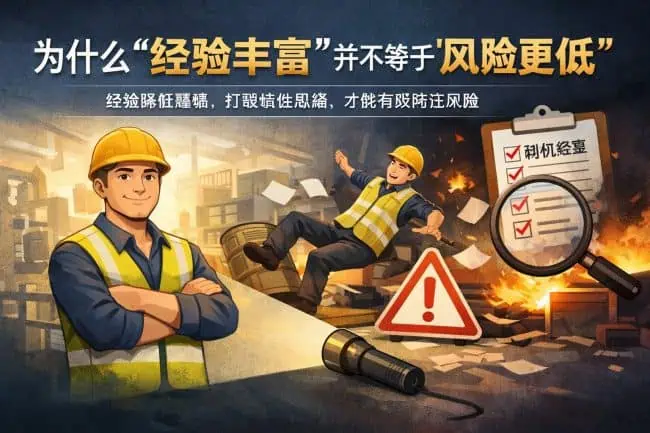
Why accidents during the resumption of work are concentrated among veteran employees

Addressing the phenomenon of why accidents during the return-to-work period are concentrated among veteran employees, the article analyzes the reasons why veteran employees, being familiar with procedures, easily develop a sense of complacency and replace standard steps with habitual operations, and points out that companies need to strengthen safety reminders and on-site supervision in the early stage of return to work to reduce accident risk.