Recently, a safety accident occurred during tunnel construction at a reservoir in Shaodong, Hunan, resulting in the tragic deaths of 3 people. This tragedy once again sounds an alarm for the safety of underground engineering. Reservoir tunnels are typical confined spaces, with complex and variable construction environments and extremely high danger coefficients, imposing stringent requirements on on-site EHS management and the selection of personal protective equipment.
The primary fatal risk in underground tunnel construction often comes from invisible gases. Due to the narrow space and poor natural ventilation, hazardous gases such as methane and carbon monoxide can easily accumulate during construction, or an oxygen-deficient environment with oxygen concentrations below safety standards may occur. This hidden environmental risk is the main cause of suffocation or poisoning of personnel.
For confined-space work, the basic sequence is ventilate, test, then enter. The atmosphere should be tested with appropriate gas-detection equipment before entry and monitored continuously during the work to confirm that conditions remain within acceptable limits.
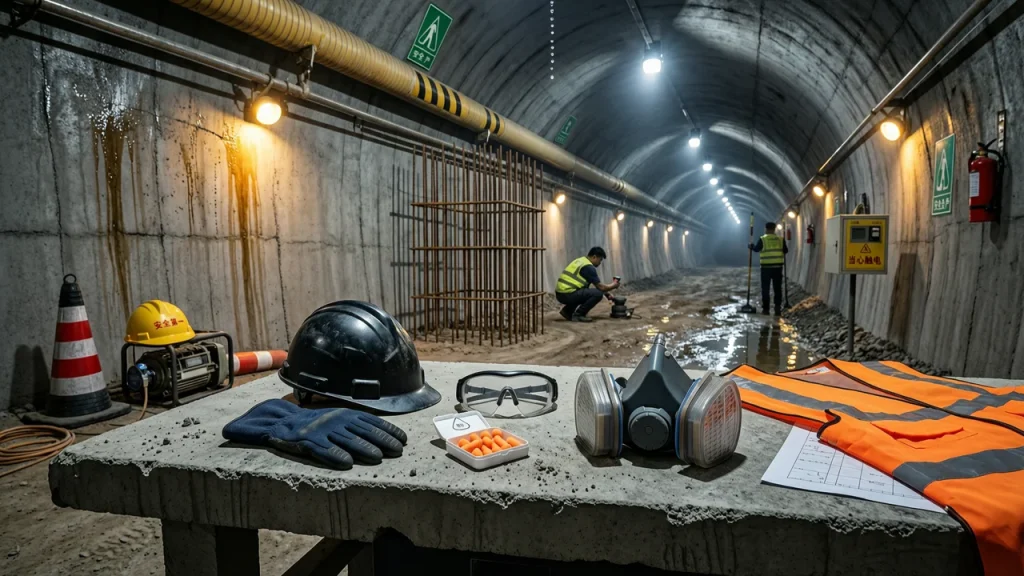
In terms of respiratory protection selection, once the risk of oxygen deficiency or toxic gases is confirmed, conventional particulate respirators are completely unable to provide effective protection. Enterprises must equip workers with high-level respiratory protective equipment such as positive-pressure self-contained breathing apparatus or long-line air supply systems, ensuring that personnel have an independent and reliable clean air source in harsh gas environments.
In addition to gas threats, geological risks inside the tunnel cannot be ignored. Loose rock layers, blasting operations, or mechanical excavation may cause rockfalls or even local collapses. Therefore, high-performance head protection equipment that meets national standards is the lifeline for workers. Safety helmets must have sufficient impact resistance and puncture resistance to effectively cushion and disperse the fatal injuries caused by falling objects.
Furthermore, the operation of large machinery and construction activities inside the tunnel generates strong echoes and noise, and long-term exposure can easily cause irreversible hearing damage. Safety management personnel should reasonably equip on-site personnel with hearing protection products such as earplugs or earmuffs. At the same time, basic protection such as slip-resistant shoes and reflective vests is also a necessary configuration to improve the overall safety level of the site.
Accidents often stem from negligence regarding the risks of confined spaces. Enterprise EHS managers and procurement departments should work together to move the safety protection threshold forward. Through formal risk assessment, strict on-site control, and professional and compliant selection of personal protective equipment, build the last line of defense for the lives of frontline construction workers.
News source:Safety Management Network, 2026-05-31: 'Construction accident at a reservoir tunnel in Shaodong, Hunan, causes 3 deaths'. This article only interprets PPE knowledge based on public news topics.