 In industrial production and construction, falls from height remain one of the leading causes of serious injuries and fatalities. From working at edges to climbing for maintenance, fall accidents often happen in an instant. Many companies have found in post-accident reviews that even when workers wore protective equipment, tragedies still occurred, exposing deep gaps in fall protection management.
A common misconception is that issuing harnesses to workers is equivalent to completing fall protection for work at height. In reality, ordinary body belts can exert a fatal impact on the lumbar spine when a fall occurs. Modern fall protection concepts have long eliminated such single equipment, instead requiring full-body harnesses that distribute impact forces to the thighs, pelvis, chest, and shoulders.
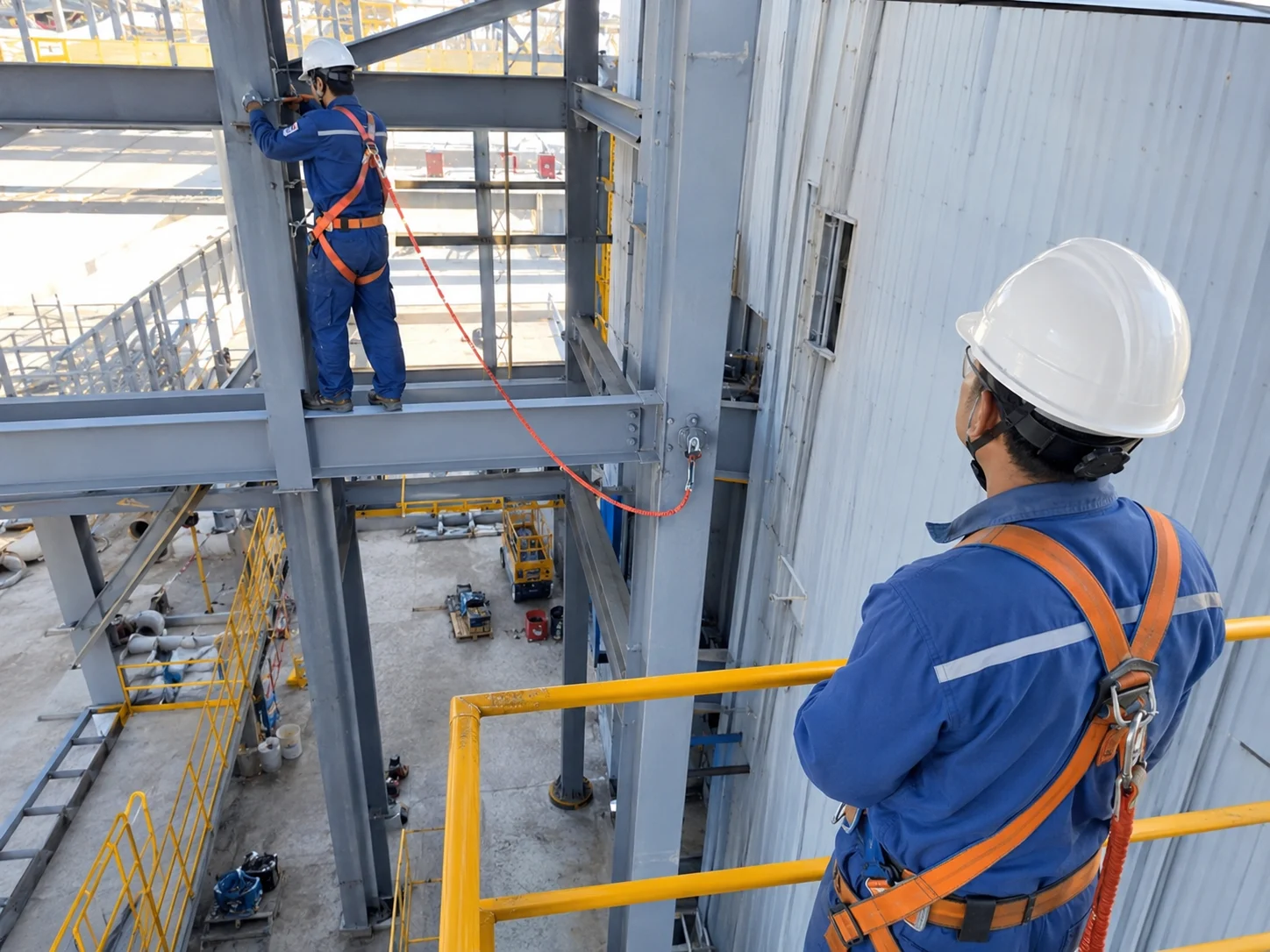
Fall protection is not merely the stacking of individual equipment but a complete system. A qualified fall protection system must include reliable anchor points, appropriate connectors, and correctly worn equipment. If anchor points lack sufficient strength or connectors are incorrectly selected, even the best harness cannot function. On-site safety management personnel must conduct a comprehensive fall risk assessment of the work environment.
During equipment selection, fall-protection systems must be matched to the specific task and fall hazard. Where fall arrest is required, use a compliant system designed to limit arrest forces and fall distance. Appropriate fall protection is both a compliance requirement and a critical control for work at height.
In addition to hardware improvements, on-site management and personnel training are equally indispensable. Safety managers must ensure that every worker at height undergoes rigorous training and becomes proficient in correct equipment donning methods, pre-use inspection procedures, and anchor point selection standards. Unverified anchor points and incorrect attachment habits are common causes of protection failure.
To prevent falls from height, companies need to establish an end-to-end management mechanism covering risk assessment, equipment selection, on-site supervision, and personnel training. Only by implementing systematic fall protection concepts into every operational detail can a reliable layer of protection be built for workers at height, ensuring every climb ends safely.
News source:Safety Management Network, 2026-07-10: "Various fall accidents from height..." This article only interprets PPE knowledge based on public news topics.