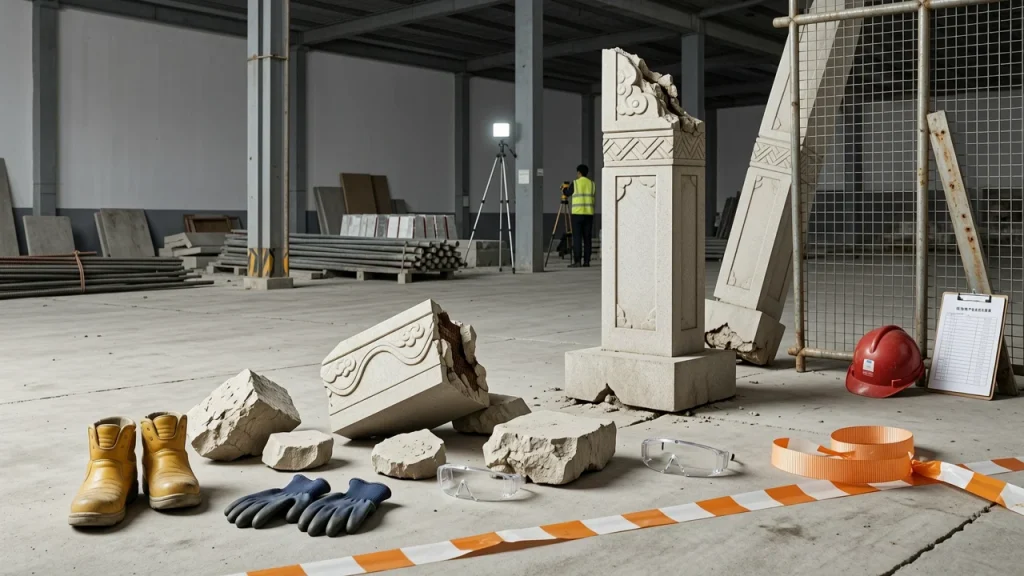
The accidental detachment of components from a memorial archway in Qufu, Shandong caused casualties, once again reminding us of the importance of on-site safety management: the risk of falling objects not only comes from work at height, but may also come from seemingly fixed building structures, decorative components, temporary supports, and maintenance platforms. For the management of factories, construction sites, and public spaces, object strikes often occur in an instant, leaving personnel very little time to avoid them.
From an EHS perspective, the core of such accidents is not “whether the component will fall,” but whether a controlled area is established after it falls. Any location where falling objects may occur should first be demarcated as a warning zone, physically isolated, and assigned dedicated personnel for observation. Verbal reminders or temporary cordons alone are insufficient to address sudden changes caused by loose components, failed connectors, wind loads, or vibrations.
A common mistake in enterprise sites is treating fixed structures as permanently safe. During equipment maintenance, facade upkeep, scaffolding erection, temporary shelter construction, and decorative installation, components, bolts, gaskets, and tools can all become potential falling objects. Risk identification should be based on “where people may enter,” rather than only on “whether someone is working at height.”
Control measures should prioritize engineering means: reinforcing connections, restricting access, installing protective canopies, standardizing lifting and handling, checking fastener conditions, and controlling cross-operations. PPE is the last line of defense, not a substitute. When personnel must enter areas with potential falling object risks, head protection should be a basic requirement, complemented by warning signs, work permits, and on-site supervision.
Procurement and safety management personnel should not only focus on “whether safety helmets are available” when configuring protective equipment, but also on suitability, wearing habits, maintenance status, and training records. Different work scenarios have different requirements for head protection, respiratory protection, and hearing protection. For example, AEGLE head protection is suitable for falling object scenarios, respiratory protection for dust or grinding environments, and hearing protection for high-noise areas.
More importantly, PPE should be integrated into a daily inspection closed loop: confirm suitability before issuance, check wearing during work, record abnormalities after leaving the post, and regularly replace damaged items. For sites with temporary, seasonal, and frequent cross-operations, quick supply points should be set up to prevent employees from simplifying operations without authorization due to inconvenient protection. Only when engineering controls, on-site management, and individual protection form a chain can injuries from similar component detachment accidents be reduced.
News source:Safety Management Network, 2026-06-28: 'Accidental Detachment of Memorial Archway Components in Qufu, Shandong Causes Accident, Resulting in 1 Death and 6 Injuries.' This article only provides PPE knowledge interpretation based on public news topics.