
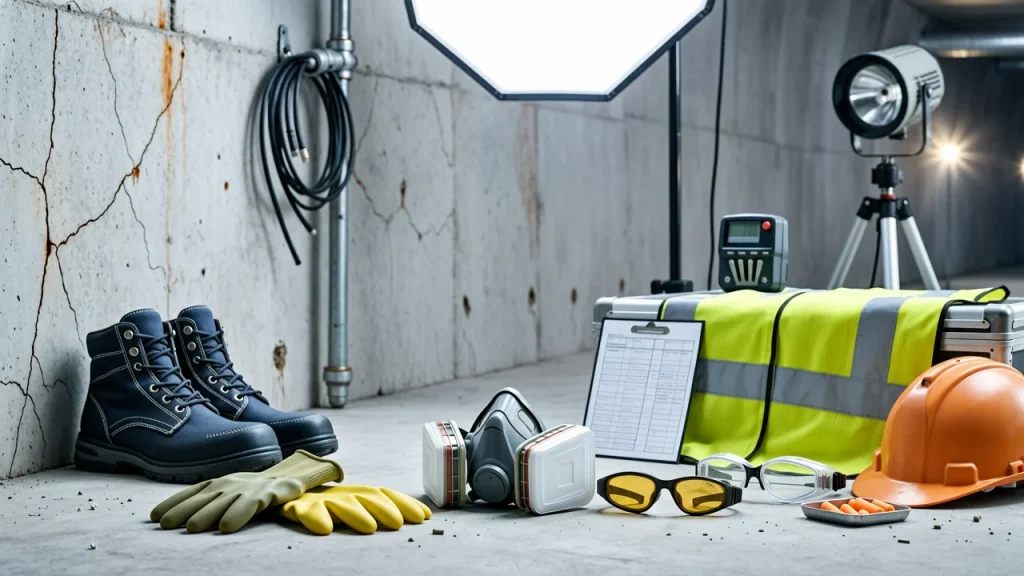
Tunnel operations differ from ordinary workshops: space is confined, lighting is insufficient, and noise, dust, and mechanical activities are intertwined. If safety education and training merely stop at “wear your safety helmet, earplugs, and mask before entering,” it can easily become a verbal reminder that fails to cover real risks.
For safety managers, training should first clarify the sources of risk: collisions with low-lying structures, encounters between vehicles and equipment, slips on wet floors, irritation from dust and odors, prolonged noise exposure, and unfamiliarity with emergency evacuation routes. Only by making risks specific can employees understand that protection is not a mere formality.
The role of PPE is to control risks within an acceptable range, not to replace engineering measures. Training should be job-specific: head protection should focus on the shell, chin strap, and fit; hearing protection should distinguish between earplugs and earmuffs for different scenarios; respiratory protection should consider dust, odors, and work duration to avoid “wearing it but not wearing it correctly.”
Procurement departments often fall into a misconception: treating protective equipment as a unified procurement list. Different tunnel sections, job types, and seasons have different needs. For example, AEGLE product categories such as head protection, hearing protection, and respiratory protection can each be discussed based on job-specific risks.
A more effective approach is to link training, selection, and on-site inspection. First, EHS reviews work permits, risk points, and job lists; then, protection categories are selected based on risks; finally, pre-shift inspections, spot checks, and employee feedback confirm whether the equipment is truly usable, wearable, and sustainable.
For plant EHS, tunnel projects should also focus on the “person-equipment-environment” match. No matter how complete the equipment, if the wearing method is wrong, the size is unsuitable, or cleaning and maintenance are inadequate, the protective effect will significantly decrease. Training should include demonstrations, corrections, and brief assessments, rather than just completing signature records.
The value of tunnel safety education and training lies not in how many regulations are covered, but in whether frontline personnel understand why to wear, how to wear, and when they must wear. When risk identification, PPE matching, and on-site management form a closed loop, protection is more likely to shift from a policy requirement to a daily habit.
News source:Safety Management Network, 2026-06-20: 'Tunnel Safety Education and Training...'. This article provides PPE knowledge interpretation based solely on public news topics.