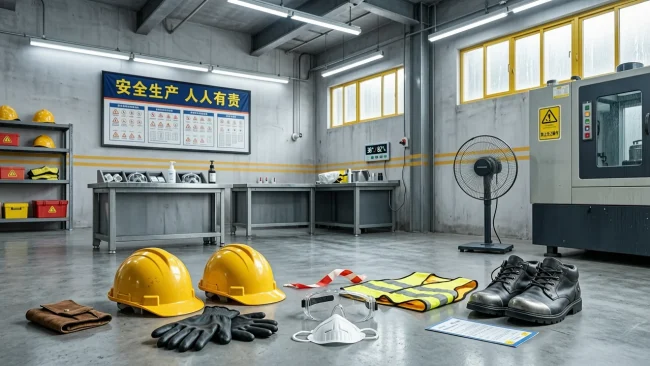
Industrial Site Protection and Supply Reserve Strategies under Geological Disaster Emergency Response

In response to the Level IV national geological disaster emergency response activated for Sichuan, this article analyzes the threats geological disasters pose to industrial sites, including falling objects caused by loosened plant components, pipeline ruptures caused by ground surface changes, and the escape of dust and gases. EHS managers need to dynamically upgrade protective equipment, focus on head protection, respiratory protection and hearing protection, and establish supply stockpile warehouses and regularly organize emergency wearing drills.

With Extreme Weather Occurring Frequently, How Can Enterprises Improve Emergency Personal Protective Equipment Reserves

The recent emergency allocation of central disaster-relief supplies by the state to support flood-control and disaster-relief efforts in multiple regions has prompted companies to reconsider their emergency supply reserves. The article points out that under extreme weather, factories face risks such as waterlogging and emergency clearance and repair work, and that temporary procurement of protective equipment is inefficient and prone to improper selection. It recommends that EHS and procurement departments establish a seasonal, scenario-based reserve mechanism, regularly inventory and replenish head, respiratory and hearing protection equipment, and ensure supplies are available in emergency situations.

With frequent extreme weather during flood season, how can industrial enterprises upgrade on-site protection and emergency supplies management?

The Ministry of Emergency Management plans to hold a flood-season safety knowledge press conference on June 23. The article points out that during the flood season, heavy rain and strong winds can easily cause damage to factory facilities, falling objects from heights, slips and falls, and electrical leakage, and chemical storage areas may also experience leaks due to backflow of accumulated water. Enterprises should upgrade head protection such as safety helmets, equip respiratory protection equipment with corresponding gas filter cartridges according to the types of volatiles on site, and take stock of dedicated protective supplies inventory in advance and check warehouse moisture-proof conditions.

Systematic Selection and Management of PPE in High-Risk Industries: Insights from Mine Safety Achievement Releases

The National Mine Safety Technology Innovation Center recently held a “Work Safety Month” achievement release event, showcasing new technologies and management experience in the mine safety field. Drawing on this topic, the article points out that high-risk industries such as mining and heavy industry face multiple risks including dust, noise and impacts, and need to establish a systematic PPE selection and management mechanism, covering selection key points for respiratory, hearing and head protection, as well as full life-cycle management encompassing needs assessment, issuance and training, wearing supervision, and regular disposal.

Observation of Industrial Site Risks and Protection Priorities under Heavy Rainfall Weather

Recently, heavy rainfall has persisted in many parts of southern China, and the situation for flood control and typhoon prevention is severe. Focusing on industrial enterprises and outdoor construction sites, the article analyzes the risks of heavy rainfall accompanied by strong winds and lightning, pointing out that head protection equipment must meet insulation standards and chin straps must be properly fastened; after heavy rain, confined spaces are prone to water accumulation and the buildup of toxic and harmful gases or oxygen deficiency, requiring scientific configuration of respiratory protection equipment. EHS managers should adjust work permits according to meteorological warnings, conduct comprehensive inspections of protective equipment after rain, and immediately dispose of and replace any found to be abnormal.

Key Points for Personal Protective Equipment Configuration During Enterprise Emergency Inspection in Response to Frequent Geological Disaster Warnings

Recently, multiple regions have activated geological disaster emergency responses due to extreme weather, and industrial enterprises in mountainous areas or involving earthworks face risks such as landslides and collapses. Focusing on the disaster warning and investigation stage, this article explains that workers face hazards such as falling rocks, dust and noise, and that head, respiratory and hearing protection equipment should be configured scientifically. It also emphasizes that enterprises should stockpile and renew supplies based on geological risk characteristics, strengthen emergency training, and integrate geological disaster prevention into daily EHS management.

During the flood season, strong convective weather is frequent. What are the blind spots in factory emergency repair PPE reserves?

The Ministry of Emergency Management recently released national natural disaster statistics, showing that severe convective weather such as rainstorms, gales and hail has entered a high-incidence period, and that post-disaster emergency repair work in factories faces secondary risks. Focusing on head, respiratory and hearing protection, the article analyzes PPE management blind spots, including chin straps of safety helmets not being fastened, insufficient mask reserves in dusty and toxic gas environments, and neglected noise protection for water pumps and generators, and recommends that companies establish dedicated PPE ledgers for extreme weather and regularly check the expiry dates and integrity of supplies.

Frequent poisoning and suffocation accidents in confined spaces: what fatal mistakes exist in protective equipment selection?

In response to the frequent occurrence of poisoning and suffocation accidents in confined space operations, the article analyzes the risks of toxic gas accumulation and oxygen deficiency due to poor ventilation in places such as sewage tanks and reaction vessels, as well as the problem of blind rescue attempts leading to expanded casualties. The article points out misconceptions in respiratory protection selection: in oxygen-deficient conditions or when gas concentrations are unknown, filtering-type gas masks must never be used; isolating equipment such as positive-pressure self-contained breathing apparatus must be provided, and it emphasizes the need to coordinate head and hearing protection as well as emergency rescue equipment and drills.

Improving On-Site Safety Management and Consistent PPE Use Before and After Holidays

The article focuses on on-site safety management at enterprises around the Dragon Boat Festival holiday, noting that schedule pressure and employee complacency can easily lead to reduced compliance with wearing personal protective equipment, while hot and rainy conditions further increase the risk of unauthorized removal. The article recommends optimizing the selection of respiratory, head and hearing protection equipment to improve comfort, and combining this with pre-holiday special training, hazard identification and on-site inspections to mitigate potential safety risks.

How EHS Managers Coordinate On-site Safety and Protective Equipment During the Dragon Boat Festival Holiday Combined with Early Summer High Temperatures

The period around the Dragon Boat Festival holiday is a time when safety incidents are prone to occur. Combined with the risks of early-summer high temperatures and the flood season, outdoor and confined-space operations face threats such as heatstroke, oxygen deficiency, and electric shock. Aimed at EHS managers, this article recommends conducting special risk inspections and emergency drills in advance, carefully selecting protective equipment for scenarios such as dust and high noise and strengthening supervision of its use, and also carrying out pre-holiday material inventory checks and special training to ensure a safe return to work after the holiday.