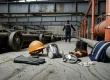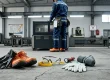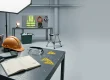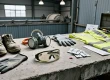
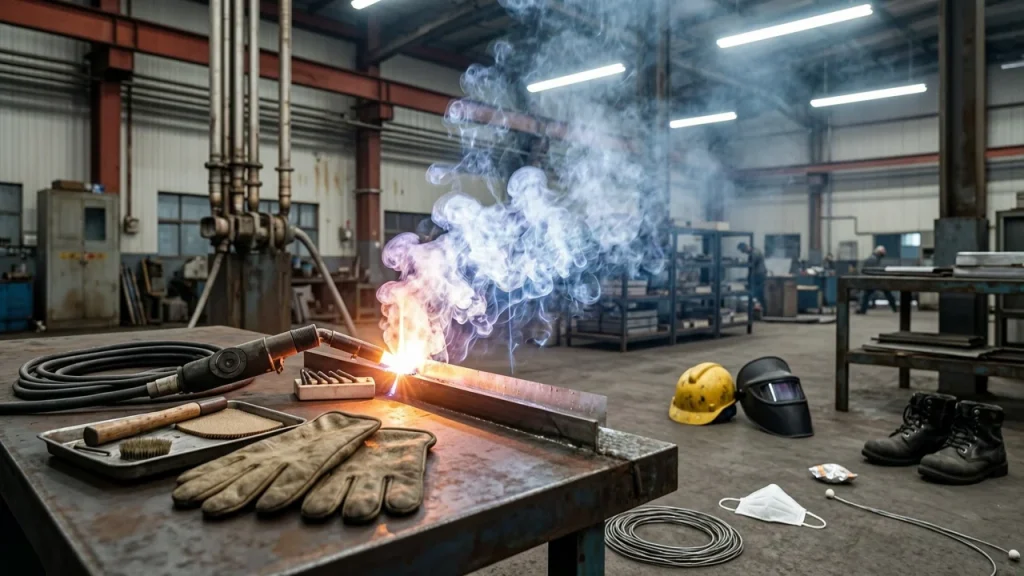
Welding work may appear to be concentrated at the weld point, but what truly affects safety is often the surrounding risk. Arc flash, high heat, fume, noise, spark spatter, and inadequate ventilation in confined spaces can all overlap at the same workstation. For factory EHS, welding is not a single process, but a risk point that requires comprehensive management by area, personnel, equipment condition, and working environment.
Many sites tend to focus on “visible” protection, such as whether a face shield is worn or whether long-sleeved workwear is worn. However, welding fume is often more insidious than arc flash, and long-term exposure may affect the respiratory system. If the work area has inadequate ventilation, complex workpiece materials, or coatings, the fume composition will also be more complex. Procurement and safety personnel should include respiratory protection in daily inspections, rather than only supplementing it temporarily for special projects.
Arc flash protection likewise cannot rely only on “good enough.” Different welding methods, different current intensities, and different working distances create considerable differences in exposure to visible light, ultraviolet radiation, and infrared radiation. A common on-site misconception is to use the same face shield for all workstations, or to judge the degree of coverage only by experience. A more reliable approach is to evaluate the suitability of head and face protection based on the welding process, working distance, and job rotation.
Noise risk is also often overlooked. Welding equipment, ventilation systems, grinding and slag removal, and nearby machinery operation can all create a combined noise environment. If welders work for long periods in enclosed workshops or narrow spaces, hearing protection should not just be “available”; attention should be paid to how it is worn, comfort, and willingness to use it continuously. Whether hearing protection is easily accepted often determines on-site compliance.
From a procurement perspective, welding protection is not a single-item purchase, but a workstation configuration. Head protection must balance field of view, stability, and heat resistance; respiratory protection must match working duration, ventilation conditions, and replacement and maintenance costs; hearing protection must consider wearing comfort and compatibility with the work. If a company has simultaneous manual welding, semi-automatic welding, grinding, and assembly crossover operations, configuration should also be based on differences in workstation risk, avoiding a “one set of equipment for everything” approach.
In terms of on-site management, it is recommended to break welding safety into three levels: before work, confirm ventilation, workwear, protective equipment, and isolation of surrounding combustibles; during work, monitor personnel condition, face shield coverage, breathing comfort, and noise exposure; after work, inspect equipment, clean slag and debris, and record abnormalities. For EHS teams, checklists do not necessarily need to be complex, but they must cover high-frequency risks and observable behaviors.
The core of health and safety in welding work is not adding more equipment, but ensuring the right equipment appears at the right workstation and is continuously used correctly. For procurement, safety, and frontline management, incorporating arc flash, fume, noise, and crossover operations into the same risk map is more valuable than emphasizing one type of protective equipment in isolation.
News source:Safety Management Network, 2026-07-24: "Welding Work Health and Safety." This article only provides an interpretation of PPE knowledge based on publicly reported news topics.