
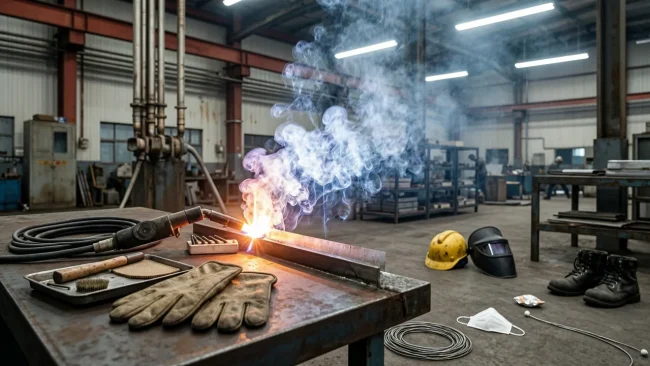
What are the commonly underestimated safety risks at welding sites?

In welding operations, surrounding risks such as arc light, fume, and noise are easily underestimated. The article points out that fume is more insidious than arc light, and long-term exposure may affect the respiratory system; when ventilation is insufficient or materials are complex, the composition is more complex; arc light protection requires assessment combined with process and distance; noise comes from the superposition of multiple devices, and hearing protection should focus on wearing method and compliance rate. Procurement should configure respiratory, facial, and hearing protection by position, and on-site management should check in three stages: before, during, and after the task.
The Right Way to Learn from Incident Lessons: From Review to a Closed Loop of Protection

The article points out that the true value of accident notifications lies in the details of risk exposure; reviews should first reconstruct the work scenario and determine whether the gap lies in management, inadequate engineering controls, or personal protection issues. The article recommends breaking lessons into actionable steps, involving procurement in the selection of protective equipment, and forming a closed loop of EHS inspections and pre-shift meeting reminders, turning a single injury into a replicable prevention mechanism.

Behind the Frequent Welding Accidents: Observation of Frontline Operation Risks and Protective Equipment Selection Approaches

Welding operations are a high-incident segment in industrial manufacturing, with frequent problems such as arc burns and inhalation of metal fumes, and the lack or improper selection of personal protective equipment is the core cause. Focusing on risks such as welding fumes, arc radiation, noise, and head protection, the article analyzes selection approaches for respiratory protection, eye and face protection, hearing protection, and flame-retardant and heat-insulating equipment, and points out that protective equipment is only the last line of defense and needs to be combined with ventilation optimization and safety training.

With Extreme Weather Occurring Frequently, How Can Enterprises Improve Emergency Personal Protective Equipment Reserves

The recent emergency allocation of central disaster-relief supplies by the state to support flood-control and disaster-relief efforts in multiple regions has prompted companies to reconsider their emergency supply reserves. The article points out that under extreme weather, factories face risks such as waterlogging and emergency clearance and repair work, and that temporary procurement of protective equipment is inefficient and prone to improper selection. It recommends that EHS and procurement departments establish a seasonal, scenario-based reserve mechanism, regularly inventory and replenish head, respiratory and hearing protection equipment, and ensure supplies are available in emergency situations.

From Passive Response to Active Prevention: Practical Paths for Risk Identification and Hazard Investigation

The article points out that industrial production safety accidents mostly stem from unidentified risks and long-accumulated hidden hazards, and that enterprises should shift away from a “firefighting” emergency-response model and carry out systematic risk identification and hazard investigation from the source. The article explains that risk identification should take into account process flows, equipment conditions and personnel operations, and that hazard investigation should establish standardized checklists and a closed-loop management mechanism. It also emphasizes matching personal protective equipment for hearing, respiratory, head and other protection according to the type of risk, so as to promote the normalization and institutionalization of safety management.