The “eight major hazards” commonly cited by industrial and trade enterprises are often not a single risk, but a combination of scenarios involving machinery, electricity, work at height, struck-by objects, vehicles, fire and explosion, poisoning and asphyxiation, and dust and noise. If procurement and safety management personnel understand this merely as "buying a few pieces of protective equipment," it is easy to end up with insufficient protection or mismatched protection.
A more common problem is that risk identification stops at the workshop level and does not extend to job-specific actions. For the same piece of equipment, exposure differs greatly between operation, inspection, maintenance, and material clearing stages; within the same team, different personnel entering confined spaces, dust locations, or elevated platforms may also require different head protection, respiratory protection, and hearing protection.
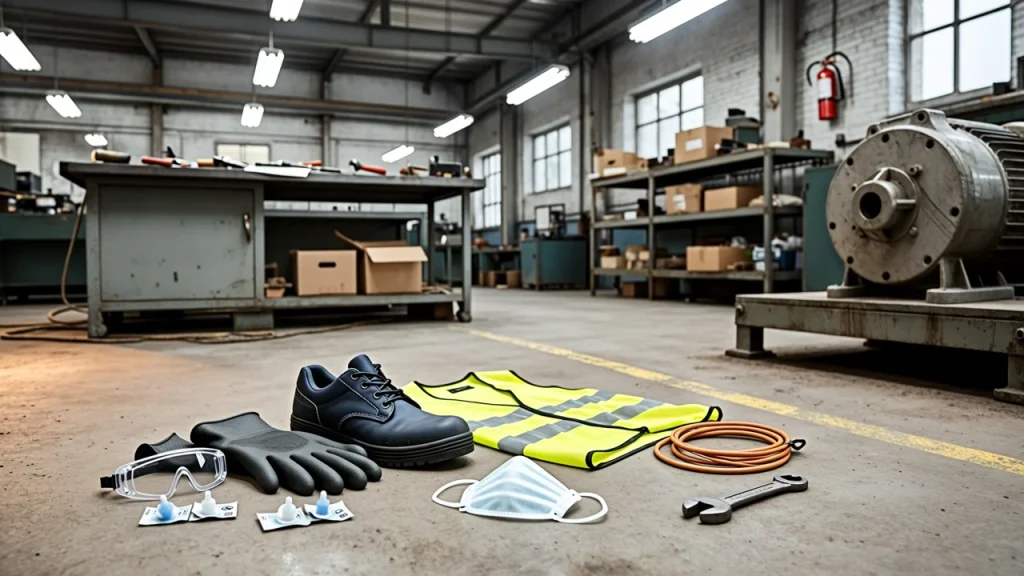
For procurement, PPE selection cannot be based only on price and appearance; it must be based on the main injury pathways in the work environment. For example, dust and particulate environments place more emphasis on the filtration fit and seal of respiratory protection, noise and impact-noise environments place more emphasis on the wearing comfort and sustained use of hearing protection, and mechanical operation and handling scenarios place more emphasis on the impact resistance, penetration resistance, and wearing stability of head protection.
Safety management personnel need to treat PPE as the last line of defense, not the only line of defense. Engineering controls, operating procedures, warning signs, and emergency preparedness still take priority. The value of PPE lies in whether, when risks cannot be completely eliminated, it can be correctly selected, correctly worn, correctly maintained, and promptly replaced at the critical moment.
What is most easily overlooked in on-site management is “wearability.” When employees do not wear PPE, it is sometimes not an attitude problem, but rather heat, ear irritation, obstructed vision, inconvenience in operation, or high replacement costs. Factory EHS can incorporate wearing experience into assessments, regularly collect frontline feedback, and include discomfort, damage, deformation, saturated filter media, or failed earplugs in inspection items.
From a selection perspective, it is recommended to establish PPE lists by job position rather than purchasing uniformly by department. The lists should clearly state the risk scenario, frequency of exposure, duration of work, alternative measures, and replacement cycle. For high-risk positions, training records and wearing inspection records should also be retained to facilitate accident review and management improvement.
Safety improvements in industrial and trade enterprises often come from small things: refining risk points from workshop names to workstations, turning protective equipment from “available” to “correct,” and turning inspections from “whether it is worn” to “whether it is worn effectively.” Such management actions can reduce the actual harm caused by the eight major hazards more effectively than simply increasing procurement spending.
News source:Safety Management Network, 2026-07-31: "The Eight Major Hazards of Industrial and Trade Enterprises...". This article only provides an interpretation of PPE knowledge based on publicly reported news topics.