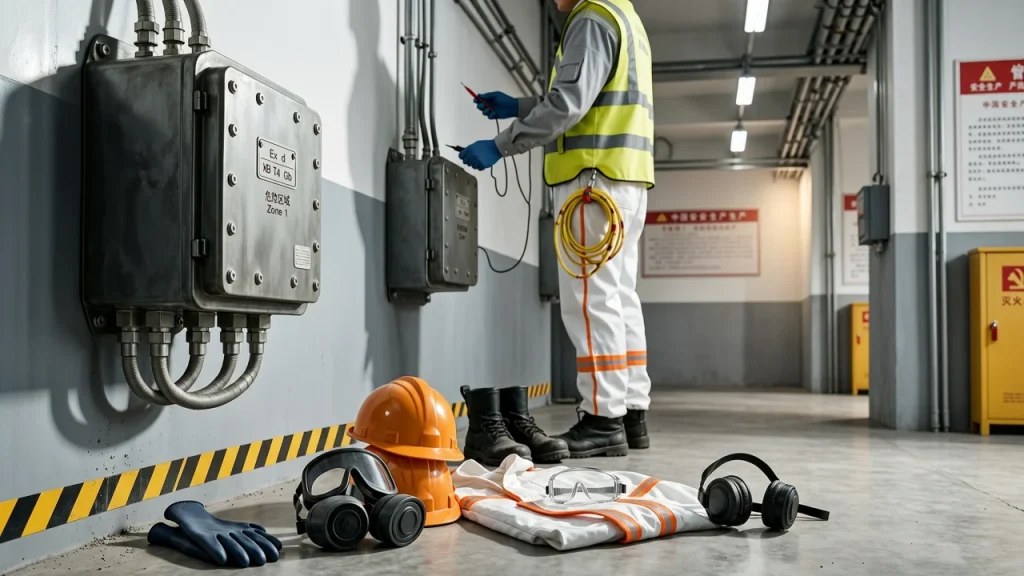
In scenarios such as chemical processing, oil and gas, and dust processing, explosion-proof electrical equipment often appears near pump rooms, tank farms, electrical distribution rooms, and process unit areas. Many people understand explosion protection as a matter of the equipment itself, believing that as long as the equipment selection is qualified, on-site personnel only need to wear ordinary labor protection. In actual operations, once personnel enter the vicinity of the equipment, they simultaneously face multiple risks from electrical, process, environmental, and ergonomic factors.
The first layer of risk in explosion-proof area operations comes from energy control. Before maintenance, inspection, sampling, tightening, or temporary wiring, if energy isolation is not in place, ordinary safety helmets, work clothing, and gloves cannot replace lockout/tagout, gas detection, and monitoring systems. The role of PPE is to reduce the probability of injury when risks cannot be completely eliminated, not to replace engineering controls and management measures.
The second layer of risk comes from environmental exposure. Equipment operation may be accompanied by noise, odors, dust, or confined space working conditions. Personnel working long-term near pump rooms and valve groups need to pay attention to whether hearing protection is suitable for wearing with safety helmets, face shields, or earplugs, and whether it affects communication. When entering areas related to dust or confined spaces, the choice of respiratory protection must match the form of contaminants, concentration, and duration of work, and cannot be decided temporarily based only on “feeling that it smells pungent.”
The third layer of risk comes from emergencies. When explosion-proof electrical equipment fails, media leaks, or fire risk rises, personnel often need to evacuate or carry out emergency response within a short time. At this point, whether head protection is secure, whether footwear and clothing hinder movement, and whether respirators are easy to don quickly will all affect safety distance and evacuation efficiency. When EHS formulates work plans, PPE should be included in escape routes, assembly points, and emergency equipment inspection content.
Misconceptions also easily arise in the procurement process. Some enterprises treat PPE as disposable labor protection, issue it uniformly according to minimum standards, and ignore exposure differences among different positions. The risks of inspection in explosion-proof areas, electrical maintenance, mechanical maintenance, and process operations are not the same. The procurement list should come from on-site risk identification, rather than simply copying ordinary workshop templates. For AEGLE categories such as head protection, hearing protection, and respiratory protection, it is recommended to separately evaluate wearing scenarios, compatibility, and replacement cycles.
In on-site management, it is recommended to incorporate PPE checks into work permits and pre-shift meetings. Before entering the vicinity of explosion-proof electrical equipment, confirm whether protective equipment is intact, whether it affects observation and communication, and whether it is suitable for the current process state. If the work involves dust, noise, or confined spaces, it should be clearly defined who is responsible for detection, who is responsible for monitoring, and who has the authority to stop work. PPE is not an attachment to a signature form, but the embodiment of risk identification results on personnel.
For factory EHS and procurement, a more prudent approach is to view the safety of explosion-proof electrical equipment, workplace environmental exposure, and personnel protection in the same risk matrix. The explosion-proof performance of equipment addresses the issue of ignition sources, while PPE addresses the issue of personnel exposure and injury consequences. Only when the two work together can “qualified equipment” be transformed into “on-site safety.”
News source:Safety Management Network, 2026-07-17: "Explosion-proof Electrical Equipment Safety...". This article only provides an interpretation of PPE knowledge in conjunction with publicly reported news topics.