
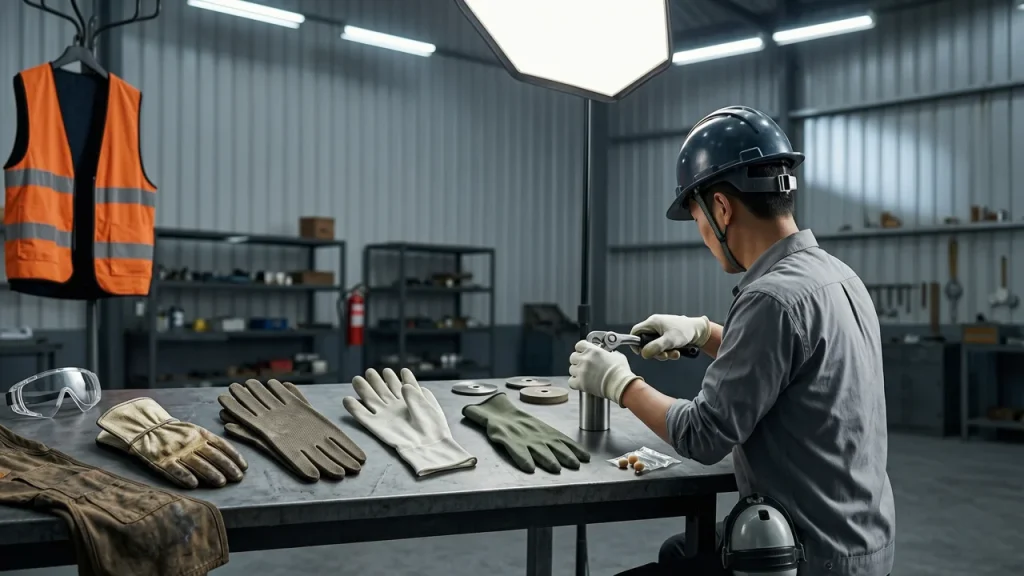
On the factory floor, cutting, grinding and assembly processes often share the same “wear gloves” requirement, but the hand risks are not the same. Cutting may cause cuts and punctures, grinding causes more abrasion, impact and vibration, and assembly is prone to injuries from pinching, oil contamination, small parts and repetitive movements. If gloves are issued in a single uniform style, protection often remains a formality.
The first step in selection is not to look at thickness or price, but to observe the work movements. Gloves that are too thick reduce tactile sensitivity and actually increase the risk of errors; gloves that are too loose may come close to rotating parts and create an entanglement risk. For procurement and EHS, the process should be broken down into specific contact surfaces, tool types, movement frequency and potential consequences before deciding on the protection category.
For cutting processes, attention can be paid to cut-resistant glove categories, focusing on whether the palm, fingertips and the area between thumb and index finger fit well while retaining sufficient dexterity. Tool changes, sheet handling and deburring involve different movements, so the glove coverage should also differ. If the work involves both sharp edges and oil contamination, grip stability also needs to be considered to prevent the gloves from slipping and causing loss of control.
The hand risks in grinding processes are often underestimated. Grinding wheels, wire brushes and angle grinding produce continuous abrasion, flying impact and vibration, so gloves should combine abrasion resistance, cushioning and fit. In long-term vibration environments, anti-vibration glove categories can be considered, but employees should also be reminded that gloves cannot replace equipment vibration reduction, tool maintenance and work-time management.
Assembly processes may appear to involve lighter injuries, but they are the most prone to pinching, crushing and fatigue-related discomfort. Small parts, bolts, springs and plastic components require fingertip sensitivity, and excessive protection may affect efficiency. AEGLE dexterity glove categories are suitable for such scenarios, but only on the premise that pinch points, moving parts and chemical contact have been identified on site, rather than simply pursuing thinness.
On-site management is equally critical. Improper glove size affects grip and tactile sensitivity; continued use after damage, oil saturation or loss of elasticity will reduce protective performance. Companies can include gloves in team inspections, set replacement criteria, and observe whether employees fold back, pull off or wear the wrong gloves for convenience.
For EHS and procurement, hand protection should not be just an issue list, but a closed loop of risk identification, on-site trials and continuous improvement. Involving frontline employees in selection can reduce the situation of “not wearing them because they are uncomfortable.” Truly effective protection is about finding the balance between risk and dexterity across cutting, grinding and assembly.