
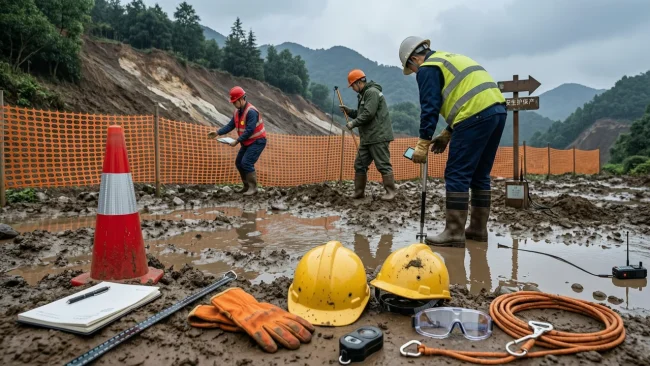
Key Points for PPE Allocation in Flood Season Geological Disaster Emergency Response, On-site Inspection, and Rescue

The Ministry of Emergency Management activated a Level IV national geological disaster emergency response for Jiangxi, Hunan and other areas, as the risk of landslides and mudslides rises during the flood season. Focusing on frontline investigation and rescue personnel, this article sorts out secondary risks at geological disaster sites such as falling rocks, dust, hazardous gases and machinery noise, proposes key points for equipping PPE such as safety helmets, respiratory protection and hearing protection, and recommends that enterprises incorporate PPE stockpiling, inspection and training into flood prevention and disaster preparedness processes.

Industrial Site Protection and Supply Reserve Strategies under Geological Disaster Emergency Response

In response to the Level IV national geological disaster emergency response activated for Sichuan, this article analyzes the threats geological disasters pose to industrial sites, including falling objects caused by loosened plant components, pipeline ruptures caused by ground surface changes, and the escape of dust and gases. EHS managers need to dynamically upgrade protective equipment, focus on head protection, respiratory protection and hearing protection, and establish supply stockpile warehouses and regularly organize emergency wearing drills.

Key Points for Personal Protective Equipment Configuration During Enterprise Emergency Inspection in Response to Frequent Geological Disaster Warnings

Recently, multiple regions have activated geological disaster emergency responses due to extreme weather, and industrial enterprises in mountainous areas or involving earthworks face risks such as landslides and collapses. Focusing on the disaster warning and investigation stage, this article explains that workers face hazards such as falling rocks, dust and noise, and that head, respiratory and hearing protection equipment should be configured scientifically. It also emphasizes that enterprises should stockpile and renew supplies based on geological risk characteristics, strengthen emergency training, and integrate geological disaster prevention into daily EHS management.

Protection Strategies for Factory Area Inspections and Emergency Rescue under Geological Disaster Warnings during the Flood Season

Recently, multiple southern provinces have activated geological disaster emergency responses, and factories in geologically complex areas such as mountainous and riverside locations face flood-season safety challenges. Focusing on operations such as plant area inspections, hazard investigations and post-disaster desilting and recovery, this article explains the role of personal protective equipment such as safety helmets, particulate respirators and noise-reduction earplugs in head, respiratory and hearing protection, and recommends that EHS managers include emergency PPE in flood prevention supply stockpile lists and regularly check expiry dates and integrity.

Geological disaster emergency response activated: how to appropriately configure protective equipment for plant rescue operations

Affected by sustained heavy rainfall, the Ministry of Emergency Management activated a Level IV national geological disaster emergency response for Chongqing and Guangxi. Drawing on flood-season plant inspections, flood prevention and drainage, and post-disaster rescue scenarios at mountain-area enterprises, this article analyzes the risks of falling objects, dust and machinery noise brought by landslides and mudslides, and recommends scientifically configuring head, respiratory and hearing protection equipment and establishing emergency supply stockpiling and wearing training mechanisms.

How Can Explosion-Proof System Abnormal Alerts Reach Decision-Makers? A Re-Examination of Corporate Safety Response Mechanisms

Using the case of a sudden anomaly in an explosion-proof device, where the enterprise responsible person simultaneously received an early warning, the article discusses how industrial safety warnings can penetrate organizational levels and reach decision-makers directly. It proposes that early warning systems should have multi-level push capabilities such as SMS and mobile applications, and be able to interface with EHS platforms; enterprises should also establish tiered response plans and regular drills, incorporate safety warnings into management performance assessments, and drive a shift from passive response to proactive prevention.